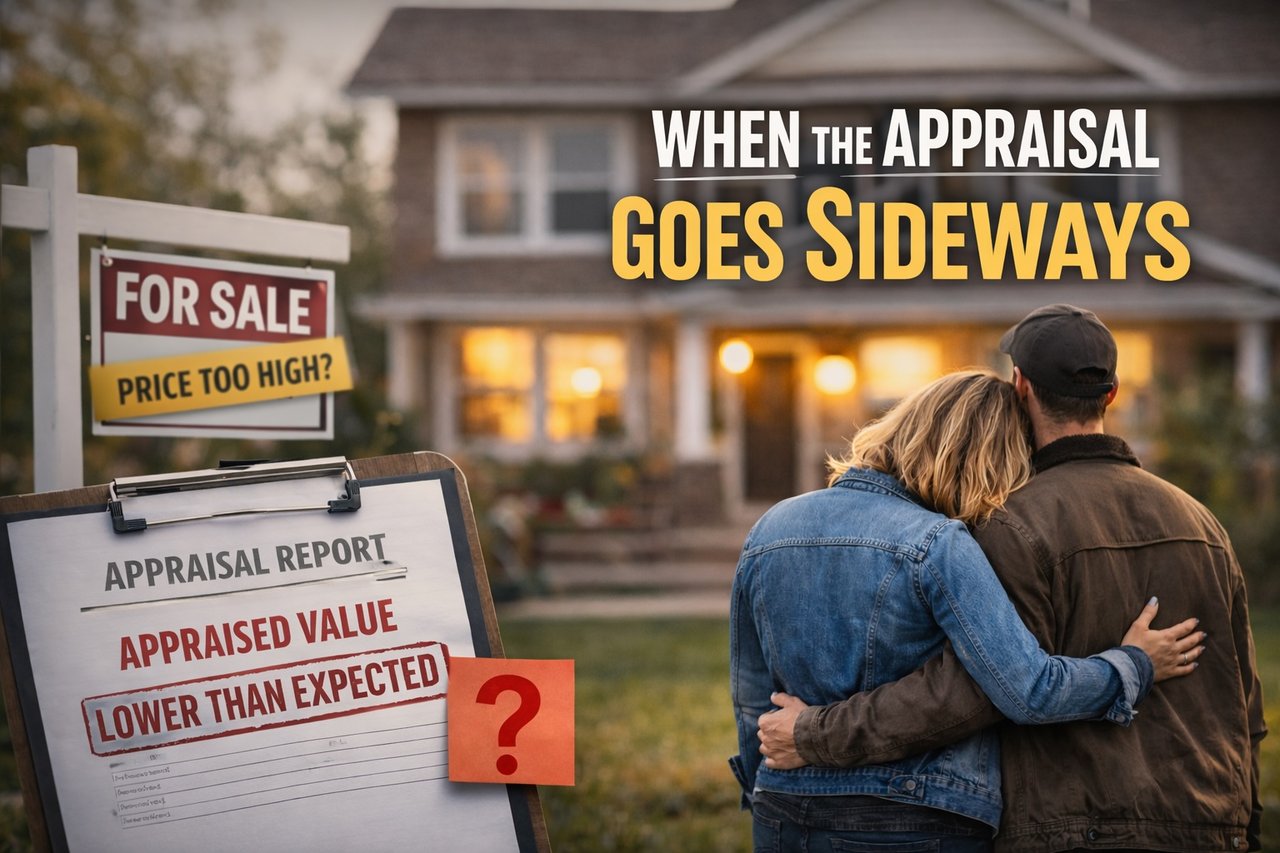
You’ve found the house.
You negotiated well.
Your mortgage is in motion.
You’re mentally picking out furniture…
…and then the appraisal comes back way lower than expected.
Cue panic.
Let’s slow this down and talk about what this actually means — and more importantly, what your options are when an appraisal throws a curveball.
First, what is an appraisal anyway?
An appraisal is the lender’s way of confirming the home is worth what you’ve agreed to pay. It’s not about the list price, what Zillow says, or how much you love the kitchen — it’s about market-supported value, based on recent comparable sales (“comps”).
And sometimes? Those comps are thin… or nonexistent.
A real-life example (yes, this actually happened)
I once represented a buyer who put an offer on a truly unique home. There were no real comps — nothing close enough to make a clean comparison.
We knew the appraisal could be tricky. What we didn’t expect was how tricky.
The appraised value came in $172,000 below the list price.
Not a typo.
Not a rounding error.
A six-figure gap.
What happens when an appraisal comes in low?
Here’s the key thing buyers need to know:
👉 The lender will only lend based on the lower of the purchase price or the appraised value.
That gap has to be addressed before the deal can move forward.
Your options (yes, you have them)
1. Renegotiate the price
Often the first move. The appraisal becomes leverage to bring the seller closer to market reality.
2. Meet in the middle
Sometimes buyers and sellers split the difference to keep the deal alive.
3. Bring additional cash to closing (the one buyers don’t see coming)
This option sounds simple — but it’s often misunderstood.
When an appraisal comes in low, buyers usually need two separate buckets of cash:
-
Their required down payment (based on the appraised value, not the contract price)
-
Plus the full appraisal gap between the appraised value and the agreed-upon price
The down payment is not automatically reduced to absorb the difference. In most cases, the lender still requires the standard percentage down on the appraised value — and the gap is added on top.
This is often a surprise to buyers who think, “I’m already putting money down — doesn’t that count?”
Here’s where strategy matters.
In the real-life situation above, we didn’t panic. We slowed the process down, worked closely with the lender, and renegotiated intelligently with the seller.
The result?
👉 A super sweet deal that left my client walking into closing with an extra roughly $75,000 of built-in equity on day one.
Depending on the loan program, buyers may also be able to restructure — putting less down to free up cash for the appraisal gap, which can result in a higher loan amount, higher monthly payment, or PMI. Every scenario is different, and every choice has ripple effects.
4. Rebut the appraisal (a “Reconsideration of Value”)
This is a data-driven request, not an emotional one. A strong rebuttal may include:
-
Missed or stronger comparable sales
-
Incorrect adjustments or overlooked features
-
Factual errors (square footage, condition, details)
-
Clear documentation to support the case
5. Request a second appraisal
Sometimes possible with the same lender — but not guaranteed. A second appraisal may be approved if the original report contains material errors or doesn’t meet underwriting standards. It must be ordered by the lender and paid for again.
6. Walk away
If the numbers don’t make sense, protecting your financial future is always the right move.
Why who you work with matters
Low appraisals aren’t just about numbers — they’re about navigation.
I work closely with trusted lenders for first-time buyers, self-employed clients, complex income scenarios, and buyers with varying cash positions. I know when to push, when to restructure, and when to pivot — calmly and strategically.
The takeaway
A low appraisal doesn’t automatically mean the deal is dead. It means you need experience, clarity, and advocacy in your corner.
If you’re buying — or thinking about it — and want guidance that’s thoughtful, strategic, and human, I’m always happy to talk through your next move.
Because real estate isn’t just about getting under contract — it’s about getting to the closing table protected, informed, and confident.
Adrienne Ward is a licensed real estate professional with a passion for helping clients find homes where their whole lives can flourish.
Serving the Lehigh Valley, PA, Bucks County, Poconos, Warren County, NJ & Hunterdon, NJ.
www.adriennewardrealestate.com